Key Takeaways
- A premium AI system needs dense GPU compute, high-bandwidth low-latency networking, liquid cooling, fast NVMe storage, and orchestration software, all specified as one stack.
- Modern AI racks draw 100 to 750 MW per site; a single GB200 NVL72 rack pulls 120 to 140 kW, versus 10 to 15 kW for traditional racks.
- Liquid cooling becomes mandatory above 40 kW per rack. Air cooling alone cannot keep high-density GPUs at full performance.
- Inference, not training, now drives long-term costs, accounting for roughly 80 to 90% of total AI compute and an expected 75% of AI energy demand by 2030.
- Capacity planning is the make-or-break decision: one team underestimated GPU needs by 400% and added $800M in emergency costs; another overprovisioned by 300% and left $120M idle.
- Meaningful enterprise GPU infrastructure starts at roughly $50 to 100M, with typical payback of 18 to 24 months.
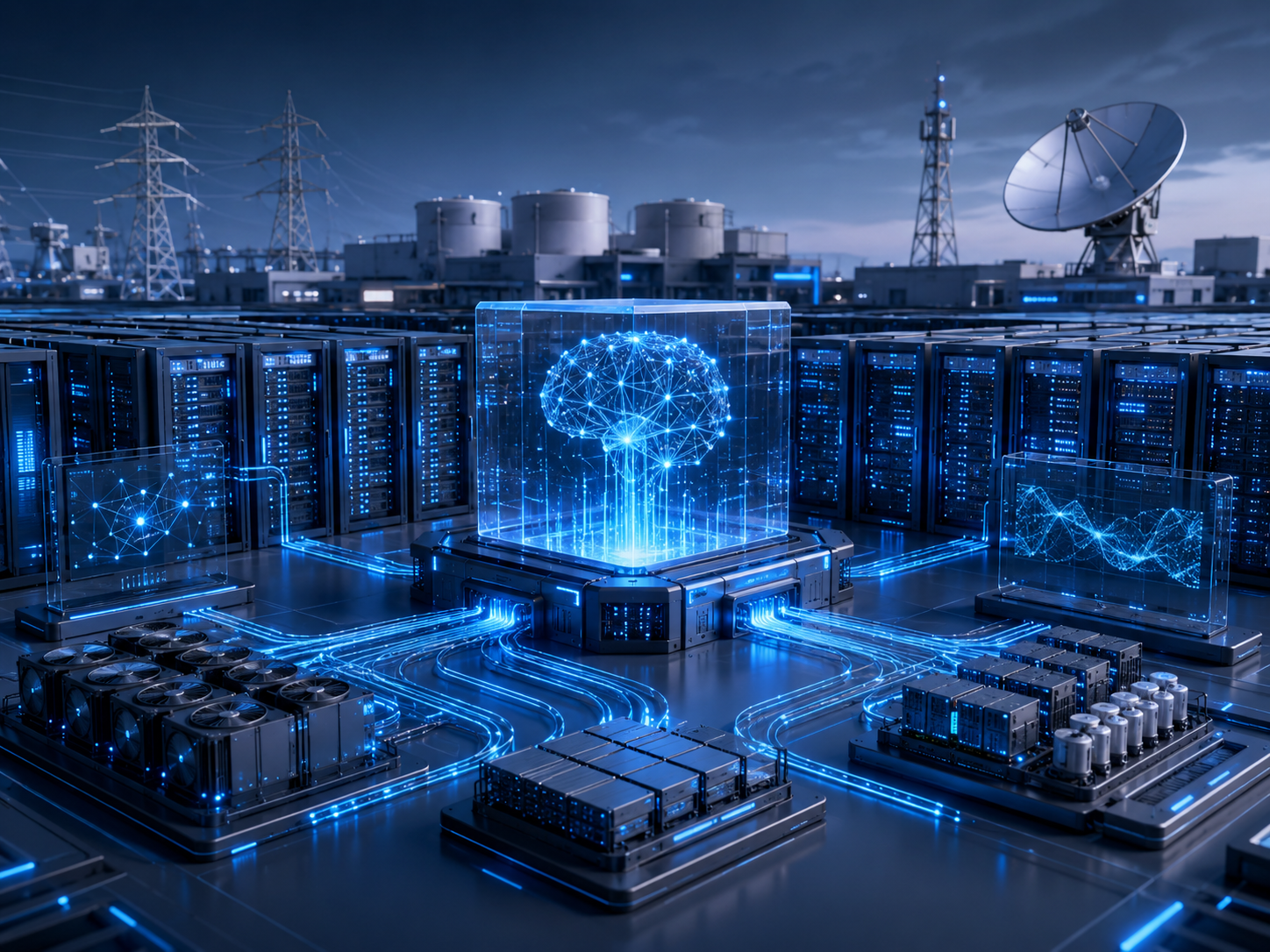
AI infrastructure system – artistic impression. Image source: Alius Noreika / AI
A premium AI infrastructure system requires four tightly coordinated layers working as one machine: dense GPU compute, ultra-fast networking, liquid cooling, and a software stack that schedules and feeds the hardware without starving it. The defining trait is density. A single NVIDIA GB200 NVL72 rack now packs 72 GPUs and draws 120 to 140 kW, roughly ten times what a traditional enterprise rack was built to handle. You cannot bolt this onto an old data center; the power, cooling, and storage all have to be redesigned around the chips.
In short, a high-end AI build is no longer a server purchase. It is an “AI factory” engineered from chip to chiller, where power delivery, thermal management, networking fabric, and orchestration software are specified together. Get one layer wrong, and the most expensive GPUs in the building sit idle. This guide breaks down each requirement, the real numbers behind it, and the planning mistakes that cost companies hundreds of millions.
Compute: The GPU Cluster at the Core
Every premium AI system starts with high-performance accelerators rather than general-purpose CPUs. The compute requirements behind today’s AI models are staggering: billions to trillions of parameters, massive memory footprints, and nonstop parallel processing across thousands of GPUs.
The current high-end is NVIDIA’s Blackwell generation. In 2024, NVIDIA introduced the Blackwell GB200 NVL72, enabling a single rack to house 72 GPUs and 36 Grace CPUs, interconnected via NVLink and high-speed InfiniBand or Ethernet to deliver 400 Gb/s scale-out networking. The roadmap moves quickly from there. Capacity planners are already tracking the path from B200 to GB300 to the Vera Rubin generation, which targets around 8 exaflops per rack in 2026.
For context on raw chip power, GPUs such as NVIDIA’s H100 and H200 provide unprecedented double-precision performance, delivering 60 teraflops per GPU. A single H100 draws about 700 watts, so a rack of eight pulls 5.6 kW for the processors alone, before any cooling, networking, or storage is added.
Why Rack Density Forces Everything Else to Change
Density is the single fact that reshapes the whole build. A single NVIDIA GB200 NVL72 rack draws 120 to 140 kW. A traditional enterprise data center built for 10 to 15 kW per rack cannot physically support these systems without full infrastructure redesign.
Modern hyperscale builds now run GPU clusters at 50 to 100 kW per rack. That density is the reason power, cooling, and storage can no longer be treated as separate facilities problems. The table below shows the gap between yesterday’s data center and today’s AI rack.
| Specification | Traditional Rack | Premium AI Rack (GB200 NVL72) |
|---|---|---|
| Power draw | 10–15 kW | 120–140 kW |
| Cooling method | Air | Liquid (direct-to-chip) |
| Primary processor | CPU | GPU |
| GPUs per rack | 0–4 | 72 |
| Workload pattern | Bursty, intermittent | Constant, intensive |
Power: The Real Constraint in 2026
Hardware efficiency is no longer the bottleneck. Grid access is. AI data center power requirements in 2026 are constrained less by hardware efficiency and more by infrastructure limits. Modern AI facilities demand 100 to 750 MW per site, driven primarily by inference workloads and high-density GPU clusters like NVIDIA Blackwell.
The scale is hard to overstate. Scale to a 50,000-GPU training cluster and the power draw approaches 35 MW, equivalent to a small city. Gartner estimates global data center electricity demand will pass 1,000 TWh in 2026, roughly double the 2023 figure. The winning approach combines grid access, on-site generation, and efficient cooling, optimizing for tokens per watt rather than the older PUE metric alone.
This is why power strategy now sits at the front of any serious AI plan. If your organization intends to deploy AI in the next 12 to 18 months, securing electrical capacity is a first-order decision, not a facilities afterthought. We highly recommend you speak to an industry expert in providing AI infrastructure solutions like Neurotechnology Cloud. They can help deploy your AI model at great capacity but also guide you in the right direction if you are unsure on what the next steps should be for your project.
Cooling: Liquid Is No Longer Optional
Once racks cross a certain density, air physically cannot remove the heat. Liquid cooling becomes mandatory for AI infrastructure, high-performance computing, and any deployment exceeding 40 kW per rack.
Most large deployments use a hybrid split rather than going fully liquid overnight. CoreWeave’s current implementation of the NVIDIA GB200 clusters will be 85% liquid-cooled and 15% air-cooled, with air still serving the less intensive CPU servers and older GPU hardware.
A premium build treats liquid cooling as a core engineering layer that runs end to end, from the chip to the chiller. As DCD framed it, processors now generate far more heat than traditional workloads, and without reliable power and effective cooling, GPUs cannot deliver full performance.
There is a catch that many teams discover late. Storage was historically air-cooled while GPUs and CPUs moved to liquid, creating a costly hybrid that captures neither set of benefits cleanly. As Hardeep Singh, thermal-mechanical hardware team manager at Solidigm, put it: “A hybrid cooling approach is an operationally inefficient situation. You’re paying for and maintaining two entirely separate, expensive cooling infrastructures, and could be exposed to the worst-of-both-world’s problems.” In a fanless, liquid-cooled rack, every component in the rack must operate natively within the same cooling architecture. SSDs, in other words, now have to be engineered to conduct heat into the fluid loop.
Storage and Networking: Feeding the GPUs
Expensive accelerators only earn their keep if data reaches them fast enough. Premium systems pair GPUs with all-flash NVMe storage to keep the data pipeline saturated during training. Completing the stack with all-flash NVMe for a fast AI data pipeline, fully integrated racks with liquid cooling options ensure fast deployment and a smooth AI training experience.
On the network side, the goal is high bandwidth and low latency across thousands of GPUs so they behave like one giant processor. That means specialized fabrics, InfiniBand or high-speed Ethernet such as Spectrum X, rather than ordinary data center networking. Across the industry, the strongest vendor stacks combine compute, validated networking, and certified storage from providers like DDN, WEKA, and VAST Data into one tested system.
The Software Layer: Orchestration and Scheduling
Hardware is only half of a premium system. The software layer decides whether you actually use what you bought. AI infrastructure requires sophisticated management tools to coordinate resources, schedule workloads, and monitor performance.
Three categories of tooling do the heavy lifting: workload orchestration that manages GPU resources, container platforms such as Kubernetes for deploying AI applications, and lifecycle tools like MLflow for tracking experiments. Effective orchestration ensures maximum utilization of expensive computing resources while giving data scientists the flexibility to experiment and innovate. Software optimization is not a minor gain here; it can yield 20 to 30% annual efficiency improvements, which directly changes how much hardware you need to buy.
Inference Now Drives the Economics
A premium system must be designed for the workload that dominates over time, and that workload is shifting. Inference accounts for approximately 80 to 90% of total AI computing, and is expected to represent 75% of total AI energy demand by 2030.
This matters for budgeting. Inference economics, not training economics, determine long-term power costs for most organizations. A fast-growing example is enterprise search and retrieval-augmented generation, where the system generates a fresh model response on every single query, consuming GPU time continuously rather than returning cached results. In regulated sectors such as finance, healthcare, and government, the compliance layer can add a further 15 to 25% to baseline GPU utilization.
Capacity Planning: The Most Expensive Decision
The costliest mistakes in AI infrastructure are not about buying the wrong chip; they are about buying the wrong amount. The two failure modes are both brutal.
Meta’s infrastructure team underestimated GPU requirements by 400% in 2023, forcing emergency procurement of 50,000 H100s at premium prices that added $800 million to their AI budget. The opposite error stings just as much: a Fortune 500 financial institution overprovisioned by 300%, leaving $120 million in GPU infrastructure idle for two years.
Sensible planning targets 65 to 75% average utilization with a 20 to 30% buffer for spikes and growth, and reserves 30 to 40% contingency for budget cycles that fall out of sync with GPU procurement. The entry price is high. Meaningful enterprise scale starts at roughly $50 to 100 million in GPU infrastructure, with typical payback of 18 to 24 months.
The market backdrop explains the urgency. The AI data center market is projected to grow from $236 billion in 2025 to $934 billion by 2030, a 31.6% compound annual rate, and McKinsey now forecasts 156 GW of AI-related data center capacity demand by 2030, requiring approximately $5.2 trillion in capital expenditure.
The Checklist for a Premium Build
A premium AI infrastructure system is the sum of decisions made together, not in sequence. The table below maps each requirement to the number that defines it.
| Layer | Requirement | Defining Figure |
|---|---|---|
| Compute | Dense GPU clusters (Blackwell, Rubin) | 72 GPUs per rack; 8 exaflops/rack target |
| Power | Dedicated grid capacity plus on-site generation | 100–750 MW per site |
| Cooling | Direct-to-chip liquid cooling | Mandatory above 40 kW per rack |
| Storage | All-flash NVMe, liquid-compatible | Petabyte-scale pipelines |
| Networking | InfiniBand or high-speed Ethernet | 400 Gb/s scale-out |
| Software | Orchestration and scheduling | 20–30% annual efficiency gains |
| Planning | Utilization and contingency targets | 65–75% utilization, 30–40% contingency |
The organizations getting this right treat the build as an integrated factory, design for inference as the long-run workload, and plan capacity with both overshoot and undershoot in mind. The chips get the headlines, but power access, thermal engineering, and disciplined forecasting decide whether the system actually delivers.
If you are interested in this topic, we suggest you check our articles:
- AI Infrastructure: Essential Components in Modern ML Systems — https://www.sentisight.ai/ai-infrastructure-detailed-guide/
- Object Detection Models — https://www.sentisight.ai/solutions/object-detection/
- Image Classification — https://www.sentisight.ai/solutions/image-classification/
Sources: NVIDIA GTC 2026 Outlook, Data Center Knowledge, Datacenters.com, Introl Capacity Planning, TechPlusTrends Power Guide, TechPlusTrends Power Requirements, Supermicro, VentureBeat, DCD, Introl Cooling, CoreWeave
Written by Alius Noreika