Key Takeaways
- Eurovision 2026’s official branding was created by humans, not AI. The Sheffield-based design studio PALS spent eight months building the logo with graphic designers, a typography studio, 3D Houdini artists, and a hand-lettering specialist.
- Some superfans accused the new logo of being AI-generated on Reddit and other forums, but agency founder Amy Bedford firmly rejects this, calling such a claim impossible for a trademark-bound global brand.
- Contest director Martin Green confirmed that songs at Eurovision will always be made by humans, calling human creativity a core principle of the competition.
- Green left the door open to AI in other areas, such as graphic design, but said tools trained on existing creative work without consent are not welcome.
- Past AI use has been minor: four AI-generated songs entered San Marino’s 2024 national selection, and none qualified.
- Individual national broadcasters are not yet bound by EBU rules on AI, so the contest currently relies on voluntary respect for human authorship.
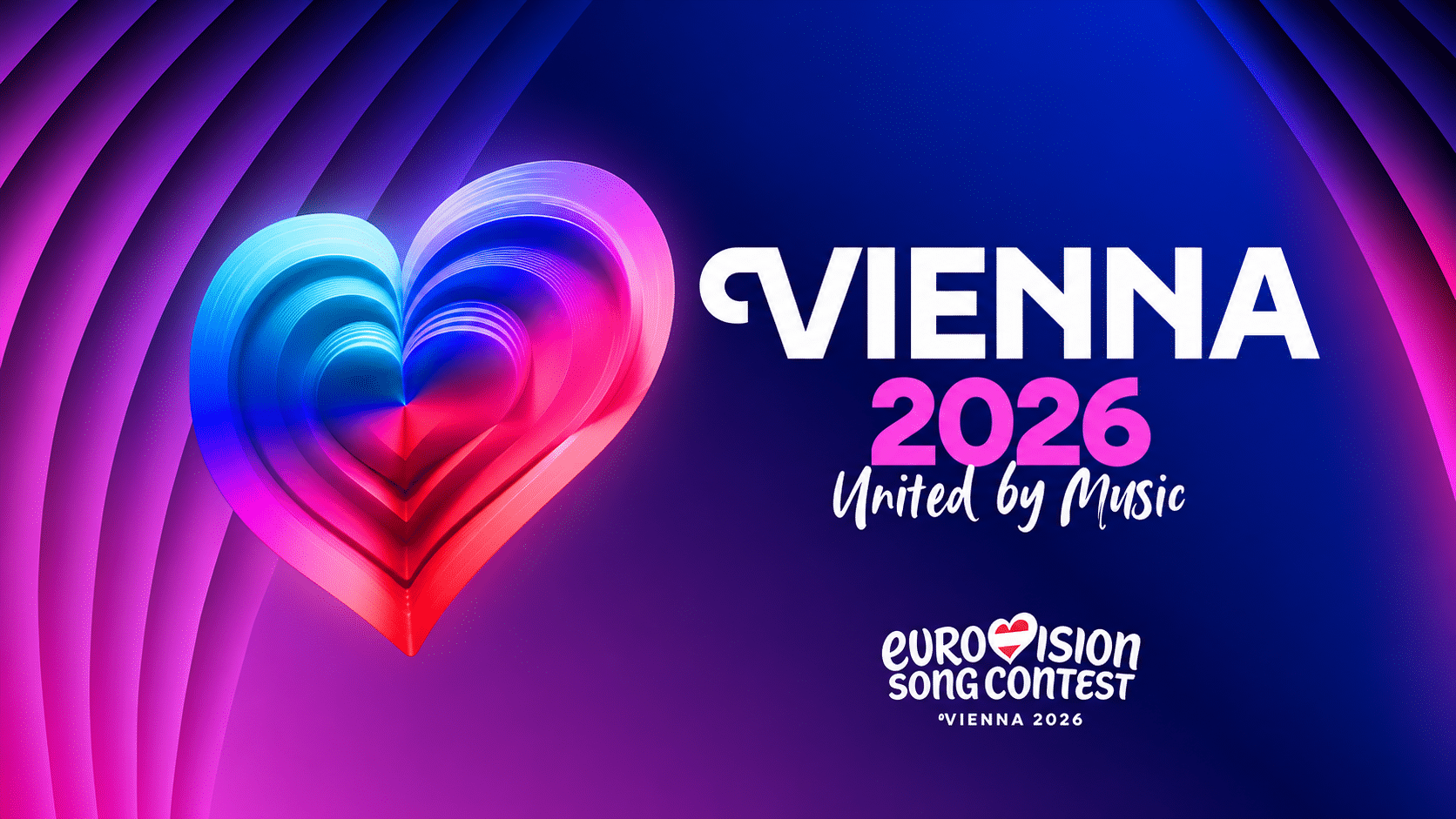
Logo of the Eurovision 2026 Song Contest. (via Wikimedia)
Eurovision 2026, held in Vienna for the contest’s 70th edition, did not replace its creators with artificial intelligence. The official logo, font, and brand symbols were made by people, despite a wave of online accusations claiming otherwise. Contest director Martin Green went further during a press event in the Austrian capital, stating plainly that the music side of the competition stays in human hands.
That said, the answer carries some nuance worth spelling out. Eurovision’s leadership has not banned AI from every corner of the production. Green ruled it out for songs while leaving room for it in visual and graphic work, provided the tools respect the rights of working artists. So the short version: no AI wrote the songs, no AI designed the official branding, but the organisation is openly preparing for a future where the technology plays some role.
The logo accusations and what really happened
The branding for the 70th contest came from PALS, a small Sheffield design agency led by Amy Bedford. Her company won the commission and watched its work appear across Vienna’s streets during contest week. The pride curdled, though, once fans got hold of the new look online.
Reddit threads and subreddit posts began circulating claims that AI had generated the logo. One commenter wrote that the design “looks like AI because AI is trained and designed to produce a corporate clean inoffensive sterile look. It’s essentially a commonality recreator machine”. The reception stung, because Bedford says the opposite is true.
“You would never ever use AI to make something as important as a brand of the Eurovision Song Contest,” she said. “It’s too big, it’s too important, it’s too loved. It’s too globally recognised and needs to be trademarked, because the client needs to earn the IP, and that needs to be very transparent.”
That last point matters. A globally trademarked brand has to demonstrate clear human authorship to hold up legally, which makes a purely AI-generated logo a poor fit for a property like Eurovision regardless of taste.
Eight months of human work behind the design
Far from a quick machine output, the logo took eight months of development. Bedford described a central idea built around the contest’s emotional core. “We had this central proposition that was all about the beating heart of the competition,” she said.
She assembled a wide team to pull it off. “I worked with different graphic designers, a typography studio, 3D Houdini artists, and I hired one of the UK’s best hand-drawn lettering logo artists to essentially evolve the logo.” The hand-drawn lettering detail directly contradicts the idea of an automated, template-driven result.
One element drew particular suspicion: a layered heart design. Bedford explained the concept of a changing emblem that shifts each year. “We created a chameleon heart that reflects that every year there will be a new iconic Eurovision heart shape, that reflects either the art or the acts of the industry,” she said. The heart was assembled from 70 distinct layers by a Spanish 3D artist. “Because the original woodwork was so good, everyone said that it was AI and made on a computer, which it had been, but with a human not a robot.”
The distinction she draws is the whole story. Digital tools and computers built the artwork, as they do for nearly all professional design. A generative AI system did not.
What Martin Green said about AI and songs
At a Q&A session with fans and media at the Wien Museum, contest director Martin Green addressed the question head-on. Asked by fan press about AI music, he was direct.
“Songs will always be created by humans,” he said. “That is a fundamental part of the creativity of this contest.”
Green did not extend that ban across every creative area. He acknowledged AI might appear in fields like graphic design, but he set a firm condition. He said AI that generates output using pre-existing creative work was not welcome, and he named “the protection of creatives” as a priority going forward.
There is a practical limit to how far that protection can stretch right now. Individual broadcasters that run their own Eurovision campaigns are not currently subject to EBU regulations on AI use. Green said the governing body can mostly watch to ensure human creativity is respected, rather than enforce a hard rule across all 35-plus participating delegations.
AI at Eurovision so far
Generative AI has stayed mostly in the background of the contest, rarely visible to a casual viewer. The most concrete example came in 2024, when four AI-generated songs entered Una Voce Per San Marino, the national final for the microstate. None of them reached the final.
The 2026 edition reignited the debate, though the focus shifted. This time the argument centres on performance graphics and visual design rather than music, driven largely by the logo controversy. Whatever side fans land on, Eurovision officials will need a clear position as the technology spreads.
A wider squeeze on working artists
The logo row sits inside a larger anxiety running through the creative industries. Several artists outside Eurovision describe AI as both a copying threat and a source of lost income.
East Yorkshire illustrator Eleanor Tomlinson saw her widely loved 2022 sketch of Queen Elizabeth II walking with Paddington Bear repeatedly recreated through AI tools. “When I see something that is my original work, that has been photoshopped, edited and gone through a process of AI and, in a lot of cases, my signature is kept on the artwork and I don’t want my name to be attached to,” she said. She has adapted by sharing her process. “I post something that was like a half-finished piece behind the scenes view, that would get more engagement than the finished piece.”
Sheffield painter Jonathan Wilkinson says he has lost freelance income to cheaper machine alternatives. “There was a particular illustration job that I had for quite some time as a freelancer,” he said. “I would get paid a decent daily rate to do it, but I guess you don’t really need to pay that anymore when you just can generate a version of it in a matter of minutes.” He now shows his pencil groundwork on Instagram to prove a human made the piece.
Graphic design lecturer Alex Watson, who teaches at Sheffield Hallam University and Doncaster College, sees a generational shift. “People are craving authenticity. They want something that’s made by a human. I think it’s really obvious when things are AI now. Things all just look the same,” he said.
Looking forward
Green’s overall message accepts that generative AI will eventually become part of Eurovision in some form. His stated priority is keeping humans at the centre of a contest that has run on human talent for seven decades. As he put it, “You have to make AI your friend, it’s not going away.”
So Eurovision 2026 was not an AI production. Humans wrote the songs and humans designed the branding. The accusations say more about how machine-generated work has trained audiences to be suspicious of any clean, modern design than about how this particular contest was actually made.
If you are interested in this topic, we suggest you check our articles:
- AI Music Industry: Is It a Threat or Ally to Artistic Creativity?
- How AI Is Giving Independent Musicians a Record-Label-Level Advantage
- The Best AI Instrumental Generators in 2026
Sources: BBC, Creative Bloq, Aussievision, Fast Company, Wikipedia
Written by Alius Noreika