Key Takeaways
- Toyota debuted its CUE7 humanoid robot at a live basketball game in Tokyo, where it stood up, dribbled, and made a free throw without human control.
- The robot stands roughly 7 feet 2 inches tall and weighs about 163 pounds, around 40 percent lighter than its predecessor.
- CUE7 uses reinforcement learning combined with model predictive control, replacing the fully scripted movement of earlier versions.
- Sensing relies on torso-mounted lidar and a stereo camera in the head; power comes from batteries adapted from Toyota’s racing program.
- The CUE project began in 2017 as a voluntary side project among Toyota employees and produced two Guinness World Records along the way.
- Toyota treats the robot as a research platform for AI, vision, and motion-control work intended for factories, cars, and consumer robotics.
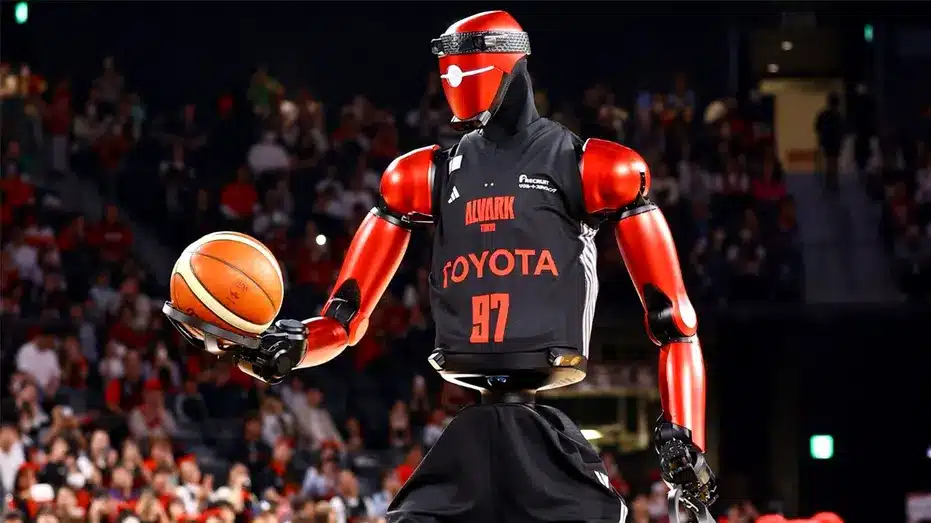
Toyota’s CUE7 robot handles the ball with precision, showing how AI can learn complex physical movement. Image credit: Toyota Motor Corporation
What Happened at Toyota Arena Tokyo
The CUE7 made its debut during halftime of a professional basketball game. It rose from a chair, took a basketball, lined up at the free-throw line, and made the shot. The smoothness of the standing motion drew an audible reaction from the crowd, and that piece of the routine took as much engineering work as the shot itself. A 163-pound machine getting to its feet without flailing requires the same balance and force coordination a human relies on without thinking.
The setting was chosen on purpose. Toyota wanted to test the robot somewhere noisy, bright, and unpredictable, with thousands of strangers watching. A laboratory floor would have proven less.
Why a Carmaker Builds Basketball Robots
Basketball requires almost everything industrial robots find difficult: identifying a target, judging distance, computing a trajectory, coordinating multiple joints, and applying a precise amount of force, all in sequence and within seconds. The same skills underpin assembly-line robotics, autonomous driving, and any robot expected to share a space with people.
Toyota chose the sport because failure is visible to everyone in the room. A missed shot is obvious. A successful one is too. There is no hiding behind metrics.
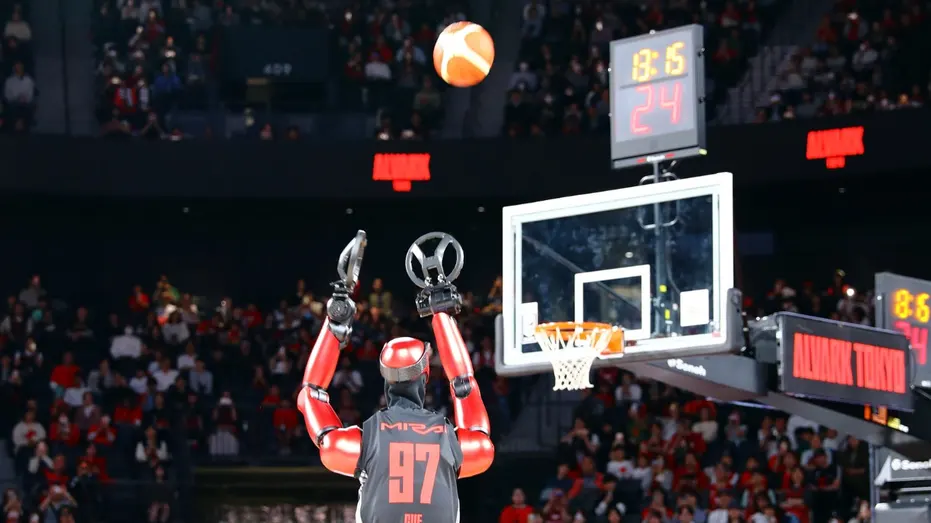
During a live game demo, the robot lines up a shot, highlighting how machines can adapt in real-world environments. Image credit: Toyota Motor Corporation
From Hand-Coded Motion to AI That Practices
Earlier CUE robots used model predictive control, a technique where engineers pre-compute the exact motion for each task. The method works, and it produced two Guinness records, but every new movement requires fresh programming.
The CUE7 instead trains itself through reinforcement learning. The robot tries a shot, sees the result, adjusts, and tries again. After enough iterations, it gets accurate, then more accurate. Toyota uses a hybrid system that pairs reinforcement learning with model predictive control, so the robot can both improvise and rely on stable underlying motion routines.
“We made full use of AI, and we discarded everything we had built up and started again from scratch,” said Tomohiro Nomi, research leader for humanoid robots at Toyota’s Frontier Research Center.
To make the motion look human rather than mechanical, Toyota fed the system human motion-capture data during training. The result is a robot whose dribble looks like a player’s dribble and whose shot follows a recognisable form.
Inside the CUE7: Hardware and Sensors
The CUE7 is taller than its predecessor but considerably lighter. Toyota simplified the structure and cut the number of axles, then swapped the four-wheel base used previously for two wheels. The change makes movement faster and more fluid, which mattered for the standing-up sequence and for any future task that involves moving across a real environment.
Sensing is split between the torso and the head. Lidar units in the torso map the surroundings, while a stereo camera in the head gauges distance and angle to the hoop. Power comes from high-performance batteries adapted from Toyota’s motorsport work.
The shot itself is a chain of calculations. The robot measures the distance, computes the angle, picks a trajectory, and releases the ball with controlled force. If it misses, the next attempt incorporates what it learned from the last one.
CUE7 vs Earlier CUE Models
| Model | Year | Notable Achievement | Control Method |
|---|---|---|---|
| CUE3 | 2019 | Guinness record: 2,020 consecutive assisted free throws | Model predictive control |
| CUE6 | 2022 | Guinness record: longest robot basketball shot, around 80 ft 6 in | Model predictive control |
| CUE7 | 2026 | Live arena debut; standing, dribbling, and shooting | Reinforcement learning plus model predictive control |
| Specification | Detail |
|---|---|
| Height | About 7 ft 2 in |
| Weight | About 163 lb |
| Weight reduction vs predecessor | Roughly 40 percent lighter |
| Mobility base | Two wheels, replacing previous four-wheel layout |
| Vision | Lidar in torso; stereo camera in head |
| Power | Batteries adapted from Toyota’s racing programme |
From Side Project to Research Platform
The CUE line started in 2017 as a voluntary after-hours effort by a group of Toyota employees. It eventually became an official program, and the team built a portfolio of records. The CUE3 set a Guinness World Record in 2019 for most consecutive assisted free throws by a humanoid robot, sinking 2,020 in a row. The CUE6 followed with a record for the farthest basketball shot by a robot, around 80 feet 6 inches.
The CUE7 is the first in the line built around AI rather than hand-coded motion, and Toyota uses it as a research platform for the broader humanoid program inside its Frontier Research Center.
Why the Arena Test Matters
“We believe it is an exceptionally valuable opportunity to validate a reinforcement-learning-based robot in the inherently uncertain environment of a basketball arena,” Nomi told CyberGuy. “Moving forward, we will continue developing robots that inspire and bring joy to people.”
The point of the test is messy real-world conditions. Lighting changes. The crowd makes noise. The robot has to operate without the controlled inputs a lab provides. Reinforcement learning is at its most useful exactly when conditions stop matching the training set, and a packed arena is one of the cleaner ways to prove the method holds up.
Where the Technology Goes Next
Toyota frames the CUE7 as a testbed for vision systems, motion control, and coordinated movement, with applications well beyond a halftime show. The same techniques could appear in factory robots that adjust mid-shift when production requirements change, in vehicles that handle unexpected road conditions more fluidly, and in home or care robots that need to operate in environments people actually live in. Each of those settings shares a feature with basketball: the conditions are not fully predictable, and a fixed script breaks the moment something unexpected happens.
For Toyota, the basketball court is a public-facing piece of a larger embodied-AI program. The free throw made at halftime is small in itself. The method behind it is the part the company is investing in.
If you are interested in this topic, we suggest you check our articles:
Sources: Fox News
Written by Alius Noreika