Key Takeaways
- Perplexity Computer orchestrates 19+ AI models simultaneously, routing each task to the best-suited model automatically.
- It runs in the cloud with persistent memory, meaning it retains your past work, preferences, and context across sessions.
- Deep research tasks that normally take hours can produce 1,500–3,000-word reports with 10–20 cited sources from a single prompt.
- Content repurposing turns one podcast episode or article into 30+ platform-specific assets in under an hour.
- Financial analysis and investment memos with charts and competitive data take roughly 90 minutes instead of a full weekend.
- The platform connects to Gmail, Slack, Google Drive, HubSpot, Notion, Linear, GitHub, and hundreds of other tools via app connectors.
- Perplexity Computer is available on the Max subscription plan at $200/month; Perplexity recently also announced Personal Computer (a Mac-based local agent) and Computer for Enterprise.
Image credit: Perplexity
Perplexity Computer is a cloud-based AI platform that runs over 19 frontier models — including Claude Opus 4.6, Gemini, GPT-5.2, and Grok — to complete multi-step workflows entirely in the background.
Launched on February 25, 2026, and available on the Perplexity Max plan at $200 per month, it works as a digital co-worker equipped with a real browser, a filesystem, and connectors to hundreds of apps like Gmail, Slack, Google Drive, HubSpot, Notion, and GitHub.
Instead of chatting with a single AI model, users describe a goal and Computer breaks it into tasks and subtasks, spinning up specialized sub-agents for each. One agent drafts a document while another gathers the data it needs. The entire process runs asynchronously, so you can step away and return to finished results. Here are five high-value tasks this system handles particularly well — all while you focus on something else.
How Perplexity Computer’s Multi-Model Architecture Operates
Perplexity Computer is not a chatbot with a search bar on top. It is an orchestration system.
At its core, Claude Opus 4.6 acts as the primary reasoning engine. But whenever a task needs a specialist, the system delegates automatically. Gemini handles deep research by creating sub-agents. Grok takes on lightweight, speed-dependent tasks. ChatGPT 5.2 manages long-context recall and broad search. Nano Banana generates images. Veo 3.1 produces video.
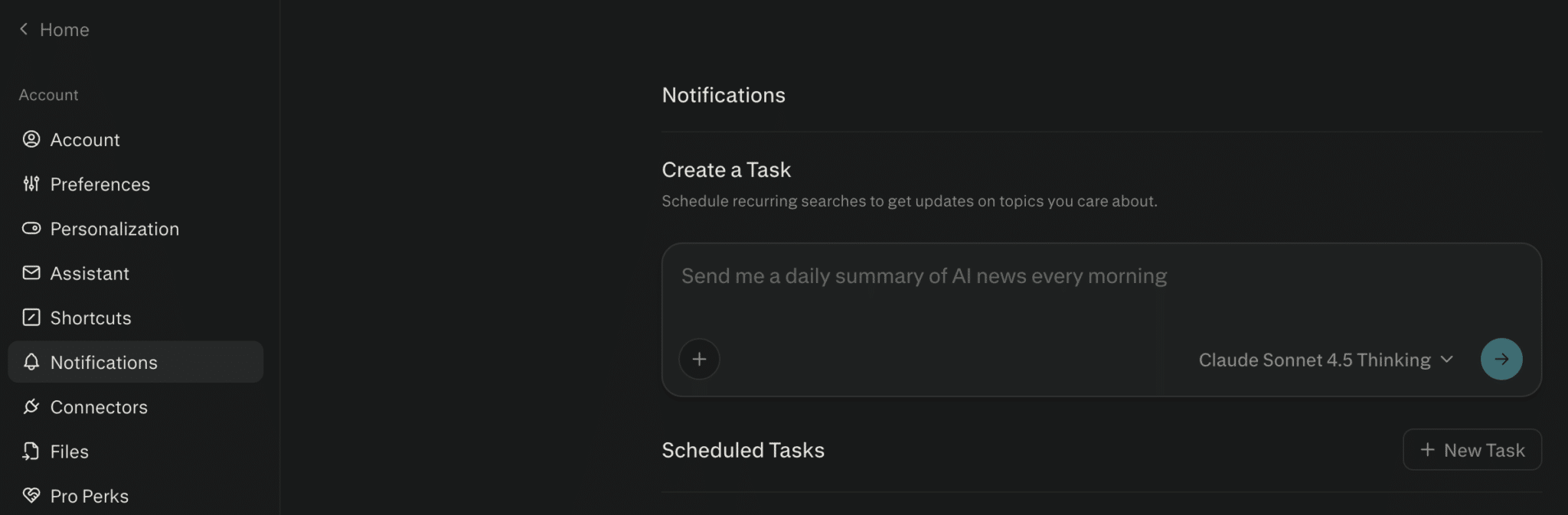
Creating a task in Perplexity computer. Image credit: Perplexity
As Perplexity CEO Aravind Srinivas put it when introducing the platform, chat interfaces provide answers, agents complete tasks, and Computer creates and executes entire workflows that can run for hours or even months.
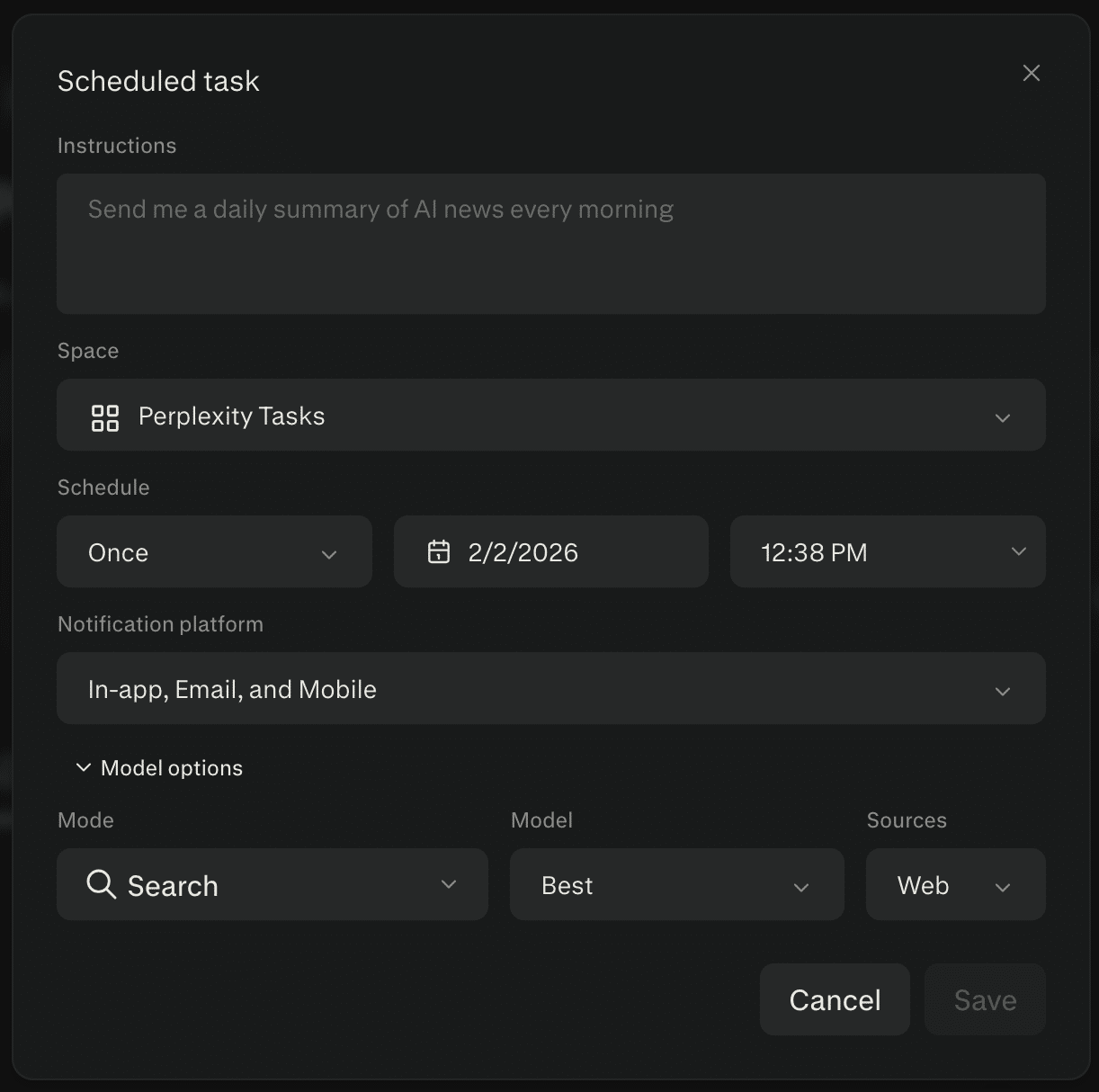
Entering prompt details in Perplexity computer. Image credit: Perplexity
Every task runs inside an isolated compute environment with access to a real filesystem and a full browser. Users can run dozens of Computers in parallel. When the system encounters a problem, it creates sub-agents to solve it — whether that means finding API keys, researching supplemental information, or writing code.
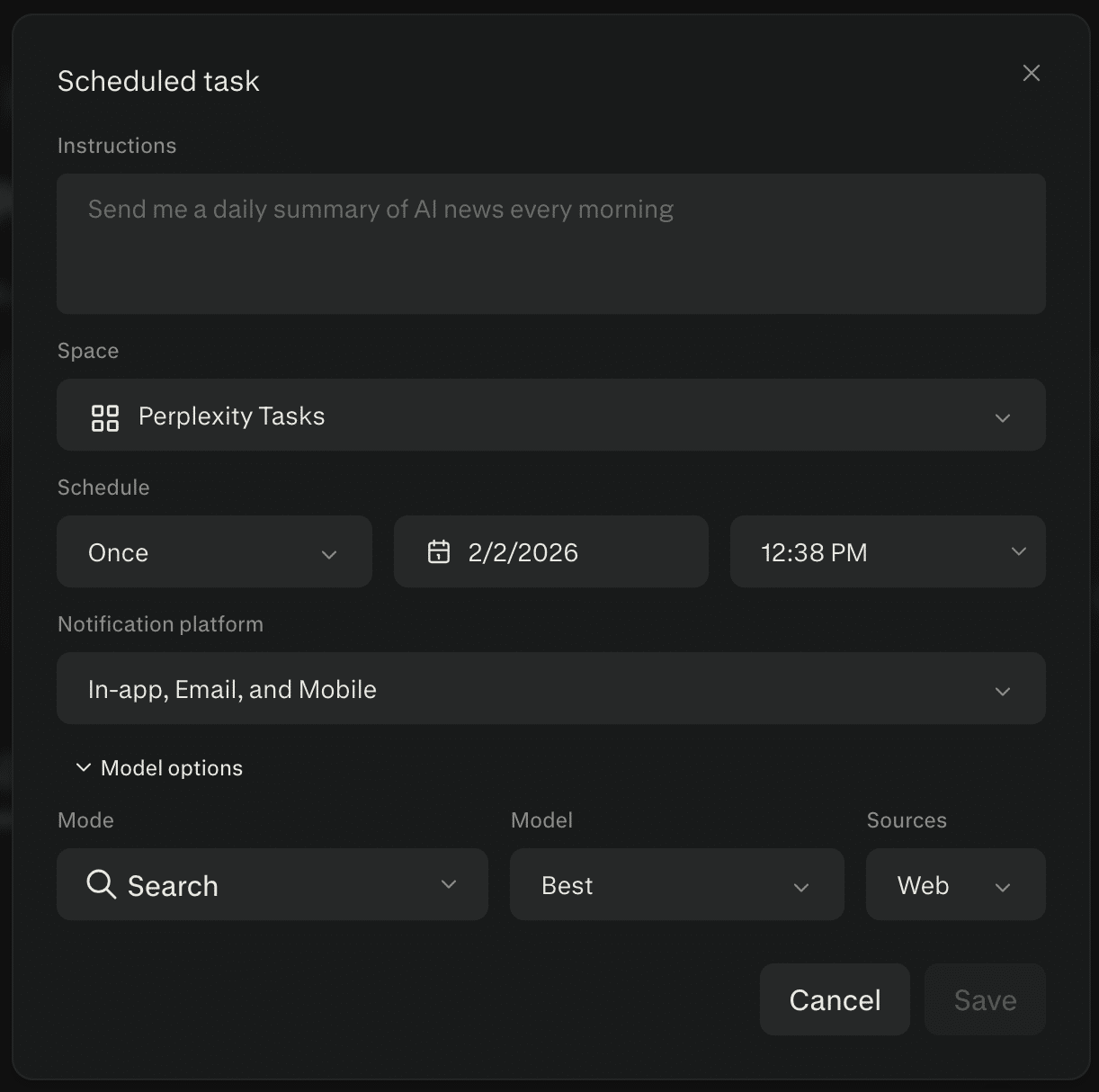
You can also create and manage scheduled tasks within Spaces. Image credit: Perplexity
Persistent memory means Computer retains context from previous sessions, eliminating the need to re-explain the same background each time. In an internal benchmark of 16,000 queries measured against institutional standards from McKinsey, Harvard, MIT, and BCG, Perplexity reported that Computer saved its own teams $1.6 million in labor costs and compressed 3.25 years of work into four weeks.
Task 1: Deep Research and Competitive Intelligence
Manually tracking competitors — checking websites, pricing pages, blog updates, social media, and job boards — eats up 30 to 45 minutes a day if you monitor just five companies. That adds up to 10 to 15 hours per month.
Perplexity Computer automates this entirely. You describe which competitors to track and what to watch for, then the system visits their websites, scrapes RSS feeds, monitors social accounts, checks LinkedIn for new hires, scans ProductHunt for launches, and compares pricing pages against previously saved versions. It only sends a report when something meaningful changes — a new enterprise plan, a pricing shift of more than 10%, a product announcement, or a social post with significant engagement.
A single research prompt can produce a detailed brief of 1,500 to 3,000 words with 10 to 20 cited sources. The system also now has access to Premium Sources, including paywalled data from Statista, CB Insights, and PitchBook, which Perplexity announced in March 2026 at its Ask developer conference. For financial queries, Perplexity Finance pulls from over 40 live tools drawing on SEC filings, FactSet, S&P Global, Coinbase, and LSEG.
What this looks like in practice
You set up a daily 8 AM monitor for five competitors. Computer checks each one for blog posts, pricing changes, feature launches, key social posts, new LinkedIn hires, and funding announcements. If Competitor A launches a new enterprise plan priced at $499 per month and positions it around SOC 2 compliance, you get a summary that morning with that detail plus any other relevant changes. If nothing happened, no email.
Task 2: End-to-End Content Repurposing
Turning a single 45-minute podcast episode into a blog post, Twitter threads, LinkedIn posts, an email newsletter segment, a YouTube description, pull-quote graphics, a Reddit post, and show notes takes 10 to 15 hours when done by hand. Computer handles the full pipeline in under an hour.
Feed it an audio file or topic, and it transcribes the episode, identifies the strongest insights, and creates platform-specific versions with appropriate tone and formatting. Twitter posts stay punchy. LinkedIn content stays professional without becoming corporate. Reddit language stays conversational. Headers, character limits, and platform conventions are all handled automatically.
The output is organized and ready to copy-paste across eight or more platforms without rewriting. For teams producing regular content — weekly podcasts, webinars, or long-form articles — this workflow eliminates one of the most tedious bottlenecks in a content calendar.
Making repurposed content perform better
Adding a simple instruction — asking Computer to suggest three different hooks per social post, optimized for each platform’s algorithm (one controversial, one educational, one storytelling) — triples the testing options for each piece of content without additional effort. Specifying voice clearly matters: generic content that reads the same everywhere performs poorly everywhere.
Task 3: Personalized Sales and Investor Outreach
Cold email response rates have dropped steadily, but hyper-personalized outreach still works. The bottleneck is research. Manually investigating a single prospect — reading their recent LinkedIn activity, checking their company’s funding status, reviewing blog posts, finding a relevant pain point — takes 15 to 30 minutes.
Perplexity Computer automates this full pipeline. It identifies decision-makers (VP of Marketing, Head of Partnerships, or equivalent), researches their recent online activity, checks funding status on Crunchbase, reads their latest published content, and drafts personalized messages referencing specific details. Connected to Gmail, it can send the messages directly or queue them for review first.
For investor outreach, the system works similarly. Describe your company and raise (stage, sector, geography), and Computer researches VCs with thesis alignment, pulls recent deals from Crunchbase, reads each fund’s public thesis from their website, maps portfolio companies to your space, and outputs a prioritized spreadsheet with partner names, emails, recent relevant investments, a fit explanation, and a priority score.
| Outreach Type | Manual Time per Batch | Computer Time | Output |
|---|---|---|---|
| Sales prospect research (10 companies) | 3–5 hours | ~30 minutes | Personalized emails with 3-email sequences |
| Investor pipeline (50 VCs) | 20–30 hours | ~1 hour | Prioritized spreadsheet with thesis alignment |
| Partnership outreach (15 targets) | 5–8 hours | ~45 minutes | Custom messages referencing recent activity |
Users report that Computer-generated VC lists sometimes outperform advisor introductions because the targeting is based on reading each fund’s actual published thesis rather than relying on general reputation or outdated directories.
Task 4: Software Development and Deployment
Perplexity Computer acts as an AI engineering co-pilot that can plan, write, test, and deploy applications from a single description. Tell it what you need — an internal tool for your team, a landing page, an automated workflow — and it handles the architecture, code generation, and deployment.
This works because Computer runs in a real compute environment with filesystem access and can create sub-agents to manage different parts of a build simultaneously. One sub-agent might scaffold the frontend while another writes server-side logic and a third handles deployment configuration. A GPT-5.3-Codex coding sub-agent was added in a March 2026 update, strengthening the platform’s programming capabilities further.
For non-technical founders and small teams without dedicated developers, this closes a significant gap. Internal dashboards, customer-facing prototypes, data pipelines, and automated Slack bots are all within reach from natural language instructions. The system handles technical implementation so the user only needs to describe the desired outcome and review the result.
Task 5: Financial Modeling and Data Analysis
Building an investment memo or market analysis manually means pulling financial data, reading earnings reports, comparing against competitors, researching analyst sentiment, constructing margin comparisons, writing bull and bear cases, and formatting it all into a readable document. That process typically takes 15 to 20 hours.
Computer generates publication-ready analysis in about 90 minutes. It loads data visualization tools, pulls CSV price histories from financial databases, scrapes recent earnings transcripts, analyzes analyst reports, builds comparison tables, creates charts, and writes comprehensive analysis with citations.
Greg Isenberg tested this during a live demo with a Shopify investment memo. Computer produced a 12-page report with financial charts, competitive analysis, and bull and bear cases from a single prompt. With Perplexity Finance now accessing over 40 live financial tools — including SEC filings, FactSet, S&P Global, and others — the depth of data available for these analyses has expanded considerably since launch.
| Analysis Type | Manual Effort | Computer Output |
|---|---|---|
| Full investment memo with charts | 15–20 hours | ~90 minutes, PDF with visualizations |
| Competitor pricing strategy breakdown | 4–6 hours | ~30 minutes, comparison tables and projections |
| Market entry analysis for a new segment | 10–15 hours | ~60 minutes, cited report with customer data |
Key Features That Make Background Execution Work
Three technical features underpin all five of these use cases.
First, persistent memory: Computer retains past work, context, and user preferences across sessions. You do not need to re-explain your company, competitors, or style preferences each time.
Second, asynchronous execution: tasks run in the cloud even after you close the browser. You launch a task before leaving your desk and pick up finished results when you return.
Third, multi-agent orchestration: the system delegates subtasks to specialized models automatically, selecting the right tool for each part of a workflow without manual intervention.
Perplexity has since expanded these capabilities. At the Ask conference on March 11, 2026, the company announced Computer for Enterprise with SOC 2 Type II compliance, SAML SSO, and audit logs. It also introduced Personal Computer, a Mac Mini-based system that gives the agent local file access with 24/7 uptime. Four new APIs — Search, Agent, Embeddings, and Sandbox — now allow developers to build on the same infrastructure that powers Computer.
What to Keep in Mind Before Subscribing
Perplexity Computer is powerful, but it is not flawless. Factual hallucinations occur, particularly on niche topics or very recent events — always verify statistics and claims before publishing. The system occasionally generates broken URLs. Complex tasks can become expensive if scope is not clearly limited. And external communications, whether emails or published content, should always be reviewed by a human before going out.
The $200 monthly price makes the most sense for users who already spend 10 or more hours per week on research, outreach, content production, or data analysis. At typical professional rates, saving even two to three hours per week more than covers the subscription cost. For founders or teams still in the idea-validation stage with minimal busywork, the return may not justify the investment yet.
The practical approach: start with one high-value workflow — competitive monitoring or content repurposing are common first choices — refine the prompt over two to three iterations, and expand from there once the system matches your expectations.
If you are interested in this topic, we suggest you check our articles:
- How Much Does Perplexity Computer Cost? Full Pricing, Credits, and Plan Breakdown
- How Does Perplexity Compare Against Other GenAI Models?
- 6 Tasks Better Suited to Perplexity Than Other AI Tools
Sources: Perplexity, Mean CEO
Written by Alius Noreika