Digital infrastructure and its development drive the emergence of innovation across different countries, becoming an integral part of the economy. In the age of artificial intelligence (AI), the number of data centers is growing, driven primarily by this technology. However, their global distribution remains uneven, and worldwide statistics reveal where the largest concentrations are located.
The Nature of Data Centers and Their Importance
These are physical facilities where installed computer servers handle the storage, processing, and transmission of data used in everyday life. Currently, the value of this industry reaches USD 242.72 billion, and it is projected to double over the next six years.
However, data processing facilities are not only the foundation of AI – they process more than 95% of global internet traffic and represent critical infrastructure for economic competitiveness and national security.
How Data Centers Are Distributed Worldwide
The growth of the digital economy and the computing power required for AI are accelerating the expansion of these facilities, but their largest clusters are concentrated in developed economies. Nevertheless, changes are also visible in other regions.
According to Statista, the list of the 30 countries with the highest number of data centers is as follows:
- United States – 4,165
- United Kingdom – 499
- Germany – 487
- China – 381
- France – 321
- Canada – 293
- Australia – 274
- India – 271
- Japan – 242
- Italy – 209
- Brazil – 195
- Netherlands – 194
- Spain – 194
- Indonesia – 182
- Russia – 180
- Ireland – 139
- Switzerland – 117
- Malaysia – 114
- Sweden – 103
- Hong Kong – 95
- Poland – 94
- South Korea – 93
- Finland – 87
- Norway – 86
- Turkey – 83
- Singapore – 78
- Denmark – 68
- Chile – 67
- Romania – 65
- Mexico – 63
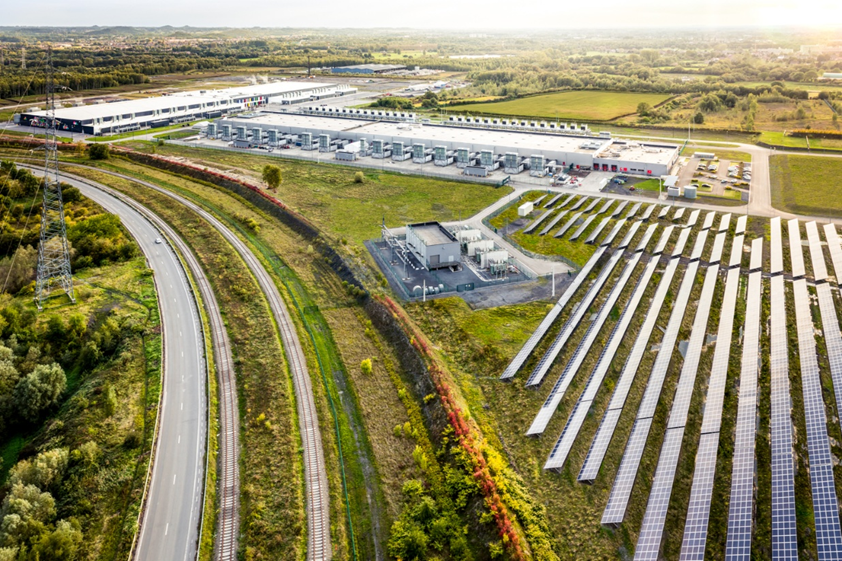
Data center in Belgium. Image credit: Google
Countries occupying the top positions in the ranking are typically home to technology giants, startup ecosystems, and innovation hubs. Therefore, the United States is the undisputed leader, hosting major technology players such as Amazon, Microsoft, Google, Meta, and others.
On the other hand, countries at the top of the list also tend to have large populations and active business sectors. As a result, demand for digital services increases. In other words, the more data is generated, the more data centers are needed.
There are also additional criteria related to geographic location, energy infrastructure, as well as government policies and strategic priorities.
Countries with 30–60 data processing facilities include:
- Israel – 61
- United Arab Emirates – 58
- New Zealand – 57
- South Africa – 56
- Thailand – 56
- Czechia – 55
- Austria – 52
- Saudi Arabia – 51
- Belgium – 48
- Portugal – 46
- Colombia – 42
- Argentina – 42
- Ukraine – 38
- Taiwan – 36
- Vietnam – 34
- Philippines – 31
- Bulgaria – 31
Another 30 countries worldwide have between 10 and 30 data centers, while approximately 70 additional countries have 1–10.
Data processing facilities consist of various types. They can be enterprise (on premises) facilities, where all IT infrastructure and data are stored locally. There are also public cloud and hyperscale facilities, where IT infrastructure resources are accessed over the internet by multiple clients. These are typically operated by major cloud service providers such as Amazon Web Services, Google Cloud Platform, IBM Cloud, or Microsoft Azure.
Finally, there are managed data centers and colocation facilities. These serve as an alternative for organizations that lack space, staff, or expertise.
Therefore, a high number of data processing facilities in a country does not necessarily indicate better infrastructure – conversely, a single hyperscale facility can be more significant than dozens of small ones.
Final Thoughts
Data centers remain a vital part of today’s economy. The wide range of countries hosting them shows that different regions of the world recognize this need and aim to establish themselves within the global digital ecosystem. Although their development is uneven, it is clear that in the future data processing facilities will become an even more significant factor in shaping technological progress, economic resilience, and national competitiveness.
If you are interested in this topic, we suggest you check our articles:
- Which European Countries Have the Most Data Centers?
- What is AI Infrastructure? A Detailed Guide on Key Components
Sources: IBM, Statista, World Economic Forum