The workplace coffee machine conversation has changed. Instead of discussing weekend plans, employees now debate whether ChatGPT wrote their colleague’s presentation or share tips for better AI prompts. This shift reflects a broader transformation in how different generations approach artificial intelligence, creating distinct usage patterns that extend far beyond traditional technology preferences.
While AI tools have become ubiquitous across age groups, the ways Americans interact with these systems reveal profound differences in comfort levels, applications, and underlying trust. The patterns emerging in 2025 demonstrate not just varying adoption rates, but fundamentally different philosophies about AI’s role in daily life.
Generation Z: The Creative Collaborators
For the youngest working generation, AI represents a creative partnership rather than a replacement. Data shows that 93% of Gen Z knowledge workers employ multiple AI tools weekly, seamlessly integrating platforms like ChatGPT, DALL-E, and Otter.ai into their workflows.
This generation treats AI as a brainstorming partner for everything from academic essays to entrepreneurial ventures. College campuses now host informal “AI clubs” where students exchange prompt strategies and ethical usage guidelines. Many are building side businesses with AI-generated content, using tools like Shopify Magic for product descriptions and Canva’s AI features for design work.
However, this comfort comes with considerable anxiety. Research indicates that 63% of Gen Z workers fear AI could eliminate their jobs, while 61% view AI literacy as essential for career advancement. Their relationship with the technology reflects both embrace and apprehension—41% report feeling anxious about AI’s implications alongside their daily usage.
Millennials: The Workplace Efficiency Experts
Millennials have emerged as AI’s most sophisticated workplace adopters, with 62% reporting high expertise levels that surpass both younger and older generations. Their approach centers on productivity optimization, integrating tools like Notion AI, Jasper, and Microsoft Copilot into professional routines across tech, marketing, and education sectors.
This generation’s AI usage extends into personal life management, reflecting their current life stage pressures. They employ AI for parenting tasks—generating bedtime stories and meal plans—while using AI-powered budgeting apps and shopping assistants for household management. Fitness-focused Millennials increasingly rely on wearables like Oura Ring and Whoop, which provide AI-driven insights on sleep patterns and recovery metrics.
The data reveals that 90% of Millennials feel comfortable using AI at work, the highest comfort level among all age groups, suggesting they’ve successfully integrated these tools into existing workflows.
Generation X: Practical Adoption with Boundaries
Generation X demonstrates selective AI adoption, focusing on applications that solve specific problems without requiring significant behavioral changes. Survey data shows that 59% use AI-powered assistants and chatbots more frequently than two years ago, but their usage patterns remain distinctly practical.
Smart home automation dominates their AI experience, with voice commands for controlling thermostats, lighting, and security systems appealing to their preference for efficiency and control. Professional applications center on administrative tasks—AI-powered scheduling, email management, and meeting transcription tools that streamline existing responsibilities.
This generation’s approach reflects a desire for AI that enhances rather than transforms their established routines, adopting tools that offer clear, immediate benefits without steep learning curves.
Baby Boomers: The Invisible AI Users
The most significant adoption challenges appear among Baby Boomers, where 71% have never used conversational AI platforms like ChatGPT. However, many regularly interact with AI without recognizing it as such—voice assistants for weather checks and music requests, AI-powered customer service chatbots, and photo organization tools in apps like Google Photos.
Industry data indicates that just 22% of employees over 65 report familiarity with generative AI, compared to 62% of Millennials. Yet 32% express hopefulness about AI’s potential benefits, suggesting that user-friendly, purpose-driven applications could increase adoption among this demographic.
The OpenAI Gap
The reluctance of older generations to engage with advanced AI applications like OpenAI’s ChatGPT highlights broader concerns about transparency and control. While 52% of Gen Z users trust AI to assist with decision-making, older generations prefer AI that remains largely invisible—embedded in existing services rather than requiring direct interaction with conversational interfaces.
This preference reflects deeper concerns about data privacy, algorithmic transparency, and the pace of technological change. Older users often express discomfort with AI systems that require extensive personal information or produce outputs they cannot easily verify.
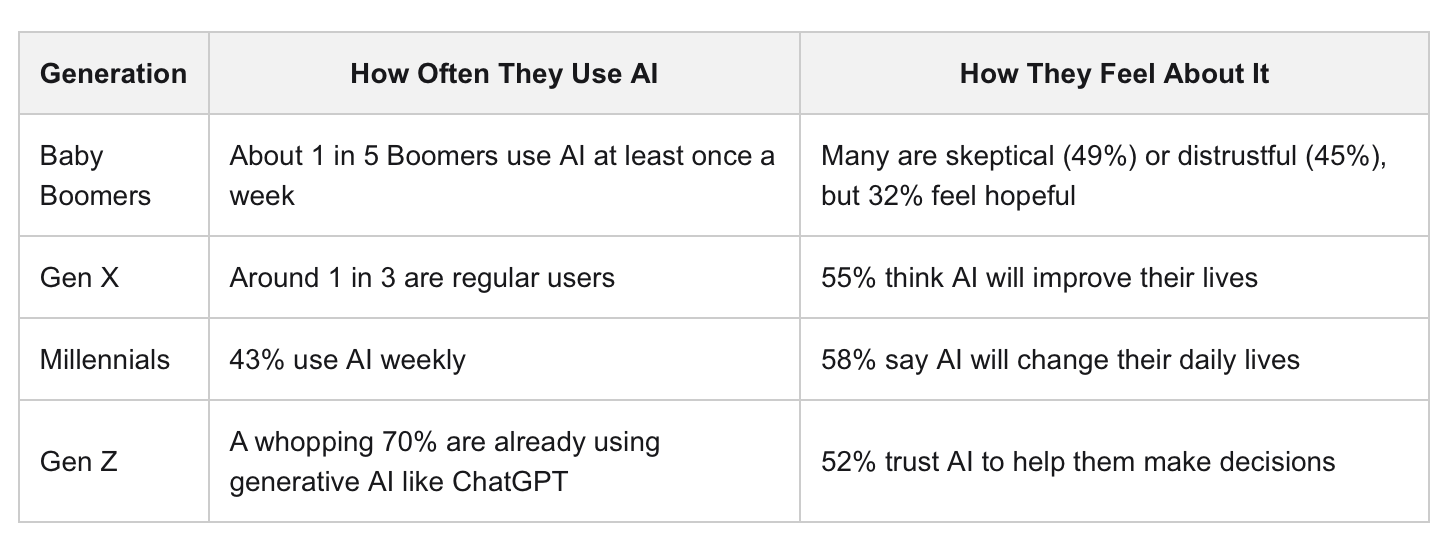
Image source: Theysaid
Understanding the Generational Spectrum
The generational AI spectrum presents both challenges and opportunities for businesses and policymakers. While younger generations drive innovation and adoption, older generations’ concerns about transparency and ease of use highlight important considerations for sustainable AI integration.
Success in understanding this spectrum will likely depend on developing AI applications that respect different comfort levels while maintaining the sophisticated capabilities that make these tools valuable. As AI continues to shape workplace dynamics and daily routines, recognizing these generational differences becomes crucial for creating inclusive technological futures that serve all age groups effectively.
Source: Theysaid