Key Takeaways
- Apple states directly that the M5 Pro and M5 Max were engineered from the ground up for AI — an unusually specific claim for a laptop chip.
- The strongest evidence is architectural: every GPU core now carries a dedicated Neural Accelerator, matrix hardware built for the maths behind neural networks.
- Apple’s marketing materials named LM Studio and Xcode by name, demonstrating local model inference and on-device agentic coding.
- The M5 Max supports 128GB of unified memory at 614GB/s, enough to hold large quantised models entirely in memory.
- Prompt processing improved most: up to 3.9x faster than M4 Pro and up to 4x faster than M4 Max, which is the phase developers feel during long-context work.
- Storage doubled at the base tier and reaches sequential speeds around 14.5GB/s, cutting the time spent loading model weights and datasets.
- The design has real limits: token generation gains are bounded by bandwidth, and batched multi-user serving still favours discrete accelerators.
- Apple’s own framing — the M5 Max is aimed at 3D animators, application developers and AI researchers — reads as a segmentation decision, not an afterthought.
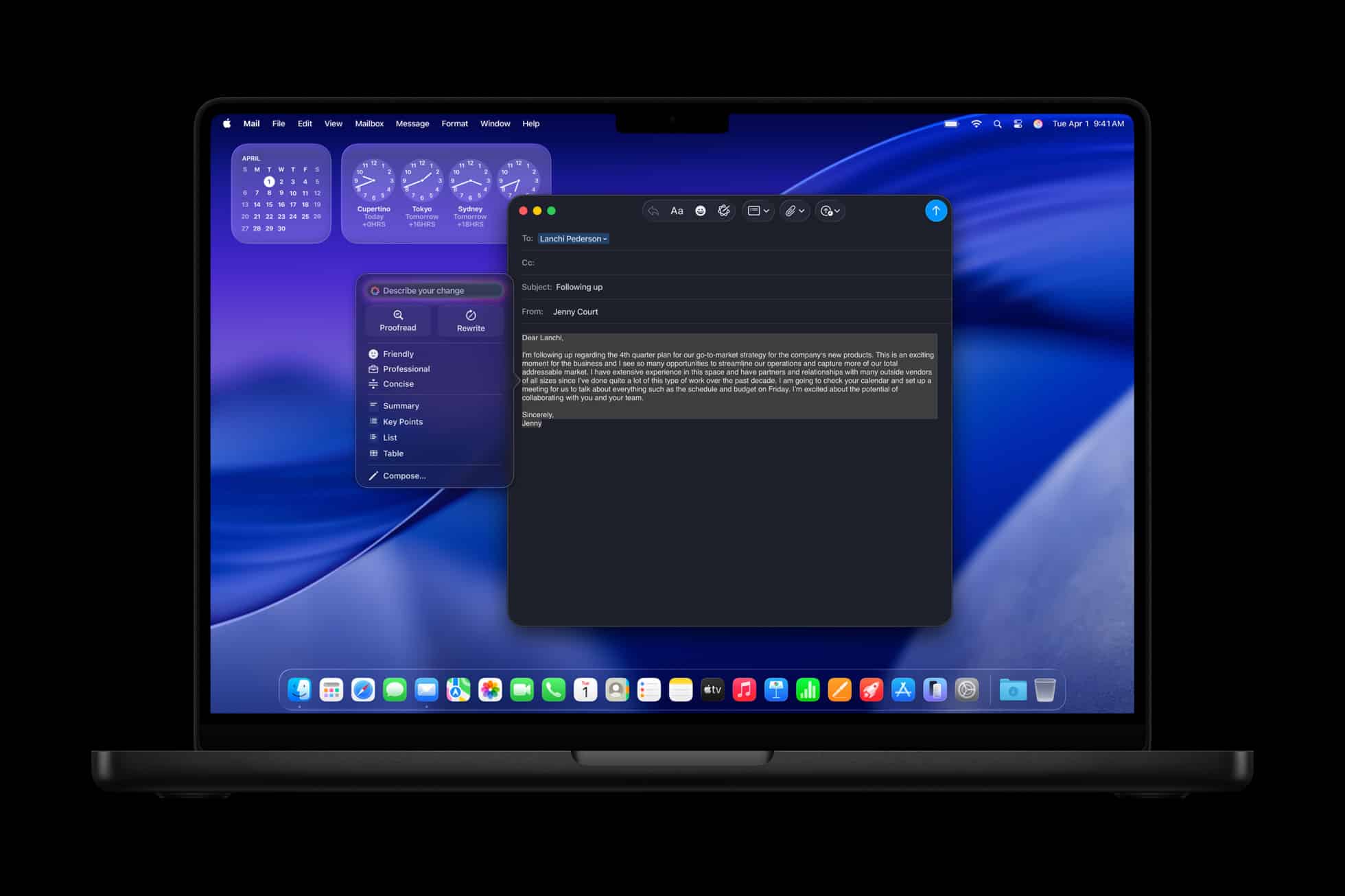
MacBook Pro with AI writing tools. Image credit: Apple
Apple’s answer to this question is unusually concise for a company that normally speaks in adjectives. Its March 2026 press materials state that the M5 Pro and M5 Max are “engineered from the ground up for AI,” and John Ternus, senior vice president of Hardware Engineering, said that with Neural Accelerators in the GPU the new MacBook Pro “enables professionals to run advanced LLMs on device and unlock capabilities that no other laptop can do — all while maintaining exceptional battery life.”
The hardware backs that claim more convincingly than the marketing language usually does — though it was built for running and fine-tuning models locally, not for training them from scratch. Understanding which of those two jobs a machine is for explains almost everything about the 2026 MacBook Pro’s specification sheet.
The Architectural Evidence
Three design decisions point unambiguously at machine learning workloads.
Neural Accelerators inside every GPU core
This is the substantive change. Rather than routing all machine learning through a fixed-size Neural Engine, Apple embedded matrix-multiplication units into each of the GPU’s cores — up to 40 of them on the M5 Max, working alongside the 16-core Neural Engine. Apple puts the result at over 4x the peak GPU compute of the previous generation for AI, and over 6x that of the M1 generation. This is not a graphics feature repurposed for AI; it is dedicated silicon for the operation that dominates transformer inference.
Memory capacity and bandwidth as first-class specifications
The M5 Pro supports up to 64GB of unified memory at up to 307GB/s. The M5 Max supports up to 128GB at up to 614GB/s. Apple explicitly tied that bandwidth increase to higher token generation for large language models. Because unified memory is shared between CPU, GPU and Neural Engine, a model that fits in memory is immediately available to the compute units without copying — a structural advantage over discrete graphics cards where video memory is a separate, smaller pool.
Storage engineered for large files
The M5 Pro now starts at 1TB and the M5 Max at 2TB, with read and write performance up to twice as fast as the previous generation, reaching about 14.5GB/s. Apple named LLMs and complex datasets alongside 4K and 8K video as the beneficiaries. Anyone who has waited for a 40GB checkpoint to load will understand why that number appears in a laptop announcement.
What Apple Chose to Demonstrate
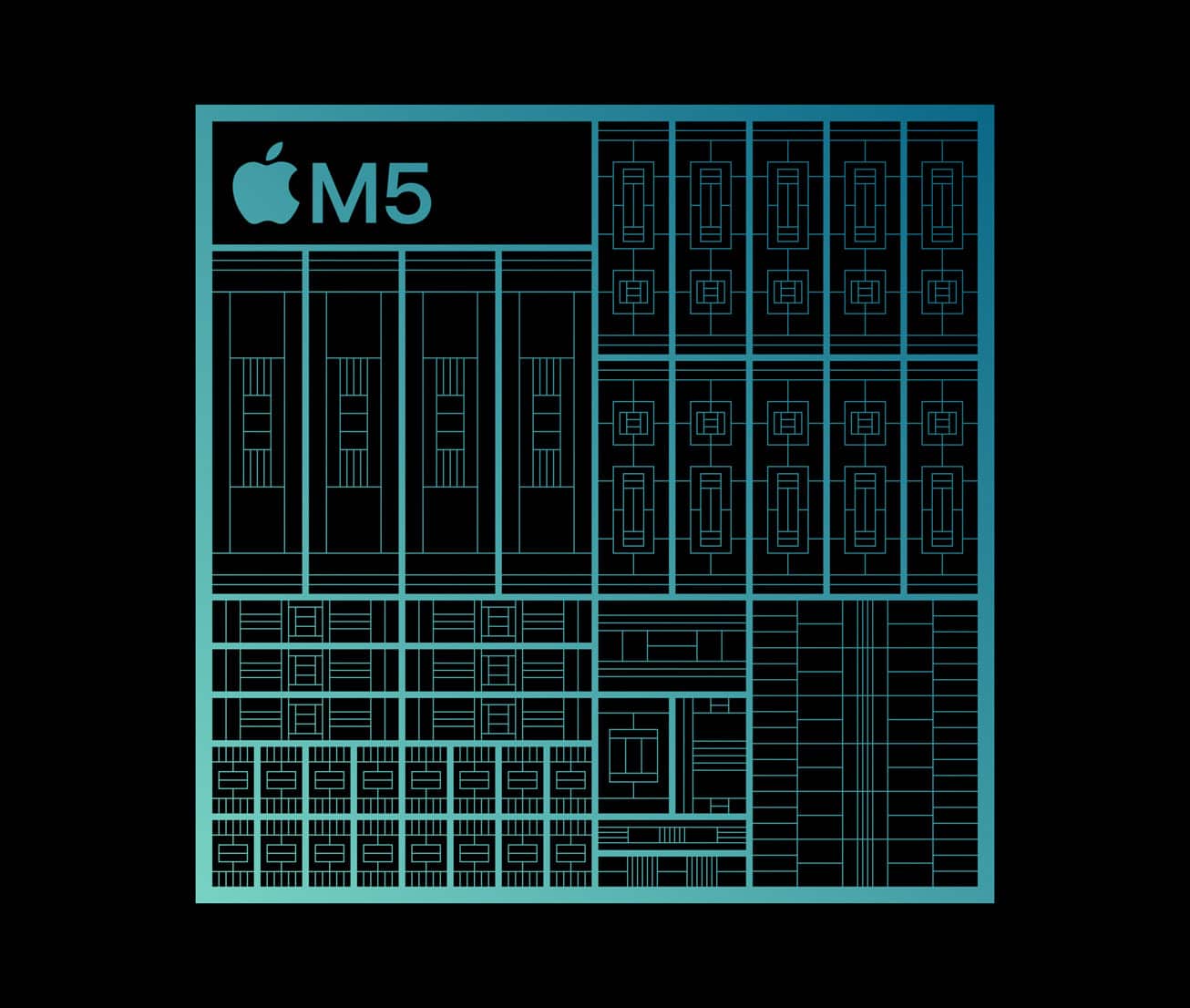
M5 unleashes next-level AI performance with its next-generation GPU architecture, powerful CPU, faster Neural Engine, and higher unified memory bandwidth. Image credit: Apple
Companies reveal their target user through their screenshots. Apple’s launch imagery for the M5 Pro and M5 Max featured LM Studio — a local model-running application — and Xcode showing on-device agentic coding. The accompanying text described accelerated code compilation and agentic coding running locally, plus image analysis in QuPath, a bioimage analysis platform.
That is a deliberate audience signal. A company positioning a laptop at video editors leads with Final Cut. Apple led with a local inference client and a code editor running agents. It also stated plainly that the hardware enables AI researchers and developers to train custom models locally — fine-tuning and small-scale training rather than foundation-model pretraining, but training nonetheless.
The segmentation confirms it. Apple describes the M5 Pro as aimed at data modellers, sound designers and STEM students, and the M5 Max at 3D animators, application developers and AI researchers. AI researchers appear on that list by name.
Measured Gains, and Where They Concentrate
| Workload | M5 Pro vs M4 Pro | M5 Max vs M4 Max |
|---|---|---|
| LLM prompt processing | Up to 3.9x faster | Up to 4x faster |
| AI image generation | Up to 3.7x faster | Up to 3.8x faster |
| AI video enhancement (Topaz Video) | — | Up to 3.5x faster |
| CPU (professional workloads) | Up to 30% faster | Up to 15% higher multithreaded |
| Storage read/write | Up to 2x faster | Up to 2x faster |
Read that table carefully and a pattern emerges. The largest multipliers belong to prompt processing and image generation — both compute-bound tasks that the Neural Accelerators attack directly. Token-by-token generation, which is bounded by memory bandwidth rather than compute, improves by a far smaller margin, roughly tracking the bandwidth increase from 546GB/s to 614GB/s plus architectural gains. Community benchmarking using Apple’s MLX framework has generally placed that figure in the 25–30% range, though results vary widely with quantisation, model build and framework version.
For developers, prompt processing is the phase you feel. Loading a large codebase into context, analysing a long document, or running an agent that reads before it writes — those are prefill operations. Apple optimised for the part of inference that determines whether a tool feels responsive, which suggests the design brief came from watching people use these tools rather than from a benchmark sheet. The shift toward agent-driven development that reshaped developer priorities over the past five years is visible in the silicon.
The Honest Limits
A laptop is still a laptop. Three constraints deserve stating.
Batched, multi-user serving remains territory for discrete accelerators, which retain a meaningful advantage when many requests run concurrently. If you are serving a model to a team rather than to yourself, the economics point elsewhere — toward the kind of hardware whose pricing is dissected in analyses of Nvidia’s RTX Spark superchip.
Foundation-model training is out of scope entirely. Fine-tuning, LoRA adaptation and small custom models are realistic; pretraining anything at frontier scale is not, and Apple never claims otherwise.
And the configuration matters more than the name. The M5 Max sold in the base 14-inch model uses a 32-core GPU with 460GB/s bandwidth; only the 40-core version reaches 614GB/s. Buying for inference throughput without checking that distinction is an expensive mistake.
The Software Half of the Answer
Hardware without frameworks is inert. Apple’s MLX framework targets the Neural Accelerators directly and is currently the fastest path to local inference on Apple silicon, with third-party tooling steadily catching up. macOS Tahoe adds the Foundation Models framework, letting developers call on-device intelligence from their own applications, and Shortcuts can now tap Apple Intelligence models directly.
The practical workflow this enables is one many developers now want: a coding agent running against a local model for routine work, escalating to a cloud model for the hard problems. That hybrid pattern is already how teams use tools such as Claude Code and comparable agentic assistants, and it is the pattern the 2026 MacBook Pro is best suited to. It is also the shortest route for anyone following a guide on building a personal AI assistant without renting a server to do it.
The Verdict
Yes — with a precise definition of what “for AI development” means. The 2026 MacBook Pro was built for developers and researchers who run, adapt and build on top of models locally, who value privacy and offline capability, and who need large amounts of fast memory in a portable machine. It was not built to replace a training cluster, and Apple has not pretended it was.
What makes the claim credible is that the AI features are structural rather than bolted on. Neural Accelerators in every GPU core, the removal of efficiency cores at the Pro and Max tiers in favour of throughput-focused designs, doubled memory bandwidth and doubled base storage are not choices you make for a press release. They are choices you make when the workload has changed.
The usual caveat applies to every multiplier quoted here: these are Apple’s own measurements on selected industry benchmarks using specific preproduction configurations, and independent results vary with thermals, memory capacity and software version.
If you are interested in this topic, we suggest you check our articles:
- Claude Code: The Agentic Tool for Coding by Anthropic
- How Much Does the Nvidia RTX Spark Superchip Cost?
- How to Develop Your Own Personal AI Assistant: A Practical Guide
- How the AI Boom Has Shaped Developers’ Interests in the Past 5 Years
- Codex vs Claude Code Upgrades: Who Is Leading Now?
Sources: Apple Newsroom (MacBook Pro), Apple Newsroom (M5 Pro and M5 Max), Apple Tech Specs, 9to5Mac, Macworld, InsiderLLM, MacRumors
Written by Alius Noreika